La suma de tus ventas es la suma de las compras de cada uno de tus clientes (finales).The addition of your sales is the addition of each of your «final» customers purchases.

Publicado en Mercados del Vino y la Distribución en su ejemplar nº 59 del 15 de noviembre al 15 de diciembre de 2010

Artículo Mercados del Vino (10.11.29) (578 x 799)

Esto ha sido siempre así. Pero, ¿Quiénes son tus clientes? ¿Aquellos que te compran directamente? Antes de aparecer Internet, casi todos ellos te compraban para revender posteriormente. Tus interlocutores en general sabían un montón de vino. Y te reunías con ellos siempre que podías, en ferias, y eventos a través de tus vendedores o porque se acercaban a la Bodega.

Te apoyabas en los grandes prescriptores, pocos y muy poderosos (Guías de vinos, premios, etc,). Si conseguías que jugaran a tu favor tus ventas podían subir como la espuma, pero si jugaban en contra …

Con la globalización y el aumento de tus exportaciones tus clientes se encontraban cada vez más lejos. Con la crisis, bajaron sus ventas y redujeron sus stocks. Y disminuyeron aún más sus compras.

Aparece Internet. Aparecen nuevos intermediarios que venden directamente al consumidor final. Y compruebas que sus compras aumentan. Te dicen que por fin puedes comunicarte directamente con el consumidor. Encargas una página web. Lo haces simplemente porque la tienen tus competidores. Pero nada cambia en cuanto a resultados.

Y compruebas que algunas Bodegas e intermediarios se mueven como pez en el agua en el nuevo medio. Algo muy importante está ocurriendo. Algo tienes que hacer. Abres tu bodega para atender el creciente turismo enológico, mejoras tus instalaciones. Te hablan de Facebook y los Social Media, pero no sabes muy bien cómo usarlo.

Y es que en este nuevo mundo no todos hablan el mismo idioma. Los hay que tienen un enorme conocimiento como importantes prescriptores o compradores que son, pero hay otros que, o saben menos o su conocimiento es distinto.

¿Cómo comunicarte con ellos cuando hablan por un medio con el que no estás acostumbrado? Porque el lenguaje en Social Media es un nuevo medio. Un medio al que hay que cogerle la temperatura. Hay que hacer lo que has hecho en otras ocasiones cuando vas a un país extranjero y no manejas el idioma local. Escuchar a través de intérpretes. Y cuando aprendes el idioma seguir escuchando. Escuchar mucho, para después, empezar a participar de la conversación. Porque están hablando de ti. Muchas veces bien y otras mal. Muchas veces con criterio y otras sin él. ¿No quieres participar en la conversación?

Y aprende que siendo importante cuanto te compran cada uno de tus clientes directos empieza a serlo mucho más la suma de las compras de tus consumidores finales, aunque no te compren a ti directamente. Y que está en tu mano convencerles de las bondades de tu producto, como lo has hecho siempre de forma presencial, pero ahora, además, por Internet.

Súbete al carro. Participa de la conversación. Búscate un intérprete, escucha, habla, conversa.

Este post en inglés: The addition of your sales is the addition of each of your «final» customers purchasesPosted in Mercados del Vino y la Distribución in Issue No. 59 of November 15 to December 15, 2010

Artículo Mercados del Vino (10.11.29) (578 x 799)

This has always been so. But, who are your customers? Are they those who buy directly from you? Before the apperance of the Internet, almost all of them bought yuor product to be resold later. In general  terms, your partners knew a lot about wine. You met them any time it was possible – at fairs or events, through your salesmen or during visits to your winery.

You used to look for support from the major prescribers, who were few and very powerful (wine guides, awards, etc.). If you managed to persuade them to play in your favour, sales could increase quickly, but if they played against

Globalization and the increase of your exportations placed customers in a more distant position. With the crisis, their sales went down so they reduced their stocks and purchases decreased even more.

Internet gets in. There are new intermediaries who sell directly to final consumers. And you realize that their purchases to you are increasing. They tell you that you can finally connect directly with the consumer. You create a website. You do it just because your competitors have it too. But nothing changes in terms of results.

And you realize that some wineries and intermediaries move smoothly in this new environment. Something very important is happening. You know that something has to be done. You open your winery to meet the growing wine tourism, you improve your facilities. You hear about Facebook and Social Media, but you do not know how to use them.

In this new world people speak different languages. There are those who have a vast knowledge -such as important prescribers or buyers, and others who know less or have a different type of knowledge.

How can you connect with them if you are in an environment completely new to you? There is a different language in Social Media. It is an environment you should analyze carefully before jumping in. 

You must do what you have done on other occasions when you go to a foreign country and you do not speak the local language. You listen through interpreters. And when you learn the language, you keep listening. Listen a lot, and then begin to join the conversation because they are talking about you and your brands. Maybe many times they are right in what they are saying and mayge sometimes not. Aren´t you looking forward to join the conversation?

One thing you are beginning to learn is the importance of the amount of sales from your direct clients, which will certainly result in more purchases from final consumers who do not buy directly from you. And now is your turn to convince them (the final connsumers) about the splendid characteristics of your product, not only through traditional means, but also through the Internet.

Get into the way. Join the conversation. Find yourself an interpreter, listen, speak and talk.

Get into the way. Join the conversation. Find yourself an interpreter, listen, speak and talk.

This post in Spanish: La suma de tus ventas es la suma de las compras de cada uno de tus clientes (finales).

La pregunta ya no es si hay que invertir en Social Media, sino cómo de bien queremos hacerlo.The question is not any more whether we do social media, but how well we do it.

La cuestión de Erik Qualman

Este post en inglés: The question is not any more whether we do social media, but how wll we do it.

La cuestión de Erik Qualman

This post in Spanish: La pregunta ya no es si hay que invertir en Social Media, sino cómo de bien queremos hacerlo.

¿Me dejas que te enseñe el cielo? La red social, o sea Facebook.Let me show you the way to heaven. «The Social Network»


He visto la red social. Me ha gustado mucho. Pero mucho, mucho. Me gusta cómo han recreado el ambiente de empresa de éxito punto com.

La película da para un debate súperextenso en muy diversas áreas.

En este post me gustaría centrarme en la importancia que tienen quienes acompañan y ayudan a Mark Zuckerberg a sacar adelante el proyecto. 

En la peli hablan de Eduardo, amigo íntimo de Mark. Eduardo le ayuda en la fase inicial y aporta el primer dinero para que el proyecto salga adelante, 18.000 $. Mark se porta bastante mal con él (¡Su mejor amigo!). De todos modos opino que si Eduardo no hubiera ayudado a Mark, éste no habría tenido problema para apoyarse en otra persona más adelante.

Están también los remeros gemelos gigantes de Harvard, que le encargan diseñar una página web. Mark estaba dándole vueltas a una idea similar, pero algo en la idea de los gemelos hace que una bombilla se encienda en la cabeza de Mark. La idea de los gemelos también le ayudó, pero era un problema de tiempo encontrar el camino, porque andaba muy cerca.

Luego nos encontramos con Sean Parker. Sean Parker había creado previamente Napster. Era alguien que pensaba a lo grande, y que había montado un buen pollo con la Industria discográfica. No había ganado un dólar con ello, pero había provocado el bombazo más grande que se ha producido en la historia de la música.

En cuanto Mark lo conoce, se da cuenta de que el discurso de Sean era el que en ese momento necesitaba escuchar. Seguramente hubiera sacado también el proyecto sin Sean. Pero creo que de todos los personajes que he mencionado Sean es el personaje más importante entre todos los que se cruzan con él. Porque le ayuda a visualizar lo grande y fantástico que puede suponer su invento.

Todo esto para decir algo sobre lo que no paramos de debatir que una idea puede ser muy buena pero no vale nada si no hay alguien con la capacidad, la energía y la motivación para ejecutarla.

Oía esta misma semana una frase tan buena, certera y sabia como escueta de la presentación de Pilar Jericó en el EBE. “Experimenta y reinarás”.

¿Y qué se necesita para experimentar de forma intensa? Motivación. Y esa motivación surge en gran parte de la capacidad de visualizar el éxito.

No sé si he sido convincente pero por si no os lo parece ahí va otro ejemplo.

Cristóbal Colón hizo 4 viajes a América. Y supongo que había que ser muy atrevido y muy emprendedor para apuntarse al primer viaje. Pero también supongo que era mucho más fácil la decisión de embarcarse a partir del segundo viaje sabiendo que Colón había tenido éxito en el primero.

Las herramientas con las que se trabaja en Social Media son mayoritariamente gratuitas. Y muchas pequeñas y medianas empresas deciden meterse en Social Media sin apoyarse en profesionales con experiencia en el sector. Y, como mucho, ponen a llevar la estrategia de Social Media de la empresa a un becario o alguien con poca experiencia profesional y/o de comunicación, y/o comercial.

Y sin embargo ningún gran anunciante se plantea entrar en Social Media sin estar asesorado por una buena agencia de Social Media. ¿Son tontos los grandes anunciantes? ¿Se gastan el dinero de forma innecesaria? Yo creo que esos grandes anunciantes han entendido que para tener éxito en Social Media es imprescindible tener muy buen producto o servicio y ser muy buenos comunicando por Internet. Considero además que la cualidad que más valoran en la agencia que contratan es la de saber que la agencia tiene muy claro qué pasos tiene que dar para conseguir éxito en Social Media, porque ya lo han hecho en otras ocasiones.

Yo creo que Sean Parker le dijo a Mark. “No tengo que imaginarme como sería el éxito si Facebook funciona. No tengo que hacerlo porque ya lo he vivido con Napster” Y que añadiría: “¿Me dejas que te enseñe el camino del cielo?”

Yo no soy Sean Parker, ni he creado Napster, pero me dirijo a las Bodegas y les digo… “¿Me dejas que te enseñe el cielo?”

Para leer otro post muy bien escrito que trata sobre la misma peli: Sobre la red social

facebook

 Post relacionados:
Si quieres darle a un águila, apunta al sol. Ricardo Lop en Iniciador Madrid
Necesito jugar más finales como ésta. Cuenta tu historia a través de Social Media.
Howard Hughes era un gurú de las nuevas tecnologías.
La primera regla del liderazgo: auténtico, original… Película sobre la vida de Bob Dylan

Este post en inglés: “Let me show you the way to heaven” «The Social Network»

I saw The Social Network on the cinema. I liked it a lot. And I mean a lot, a lot! I liked how they recreated the atmosphere of a successful dot-com company.

The film has scope for intense debates in several different areas, but in this post I’d like to focus on the importance of Mark Zuckerberg’s helpers in making a success of the project.

In the movie, a close friend of Mark’s, Edward, helps him at the beginning and stumps up $18,000; and Mark behaves rather badly towards him – his best friend! In any case, I think that even if Edward hadn’t helped him with the money, Mark wouldn’t have had any problems finding someone else.

Then there are the giant twin rowers from Harvard, who hire him to design a web page. Mark was thinking about a similar idea, but something about the twins’ idea makes something click in Mark’s head. The twins’ idea also helped him, though it was only a matter of time before he found the way.

Then there’s Sean Parker, the creator of Napster. He was someone who could think big and who upset the music industry quite a lot. He didn’t earn a single dollar doing that, but he did create the biggest all-time stir in the music industry!

When he meets Sean, he realizes that what Sean’s saying to him is just what he needs to hear. He’d have managed to carry on without Sean, but of all the people he comes in contact with, Sean is the most influential – because he makes him realize how big and fantastic his project is.

All of the above is just to say that an idea can be as fantastic as you like but it’s not worth anything there’s no one there with the ability, energy and motivation to make it a reality.

This week I heard a really good saying, which is also short, wise and true: “Experiment and you will triumph” ,from Pilar Jericó in EBE.

What does one need in order to experiment intensely? Motivation! And motivation comes mainly from the ability to see your success.

I don’t know if I’ve convinced you, so here’s another example:

Christopher Columbus made four trips to America, and I suppose that one would have had to be very daring and adventurous to join up for the first trip. I also suppose that that it would have been much easier for someone to join up for the second, third and fourth trips, knowing that the first was a success.

The tools we all have available to work with in Social Media are mostly free. Many small and medium sized companies decide to go into Social media without any support from professionals with experience in the sector. At the most they might give the job to an intern or to some other employee with little or no experience.

Y sin embargo ningún gran anunciante se plantea entrar en Social Media sin estar asesorado por una buena agencia de Social Media. ¿Son tontos los grandes anunciantes? ¿Se gastan el dinero de forma innecesaria? Yo creo que esos grandes anunciantes han entendido que para tener éxito en Social Media es imprescindible tener muy buen producto o servicio y ser muy buenos comunicando por Internet. Considero además que la cualidad que más valoran en la agencia que contratan es la de saber que la agencia tiene muy claro qué pasos tiene que dar para conseguir éxito en Social Media, porque ya lo han hecho en otras ocasiones.

Funnily enough, no large company gets into Social Media without hiring one or more professionals. Are these large companies crazy? Are they throwing their money away? I don’t think so. I think that they’ve realized that to be successful in Social media you have to have a good product or service to start off with and be very good at communicating over the internet. I also think that the qualities they value when hiring professionals is that they have a proven track record of similar successes in the past.

As Sean Parker said to Mark: “I don’t need to imagine what success will be like if FaceBook succeeds. I don’t need to because I already know! I lived it with Napster. Let me show you the way to heaven”

I’m not Sean Parker, and I didn’t create Napster, but what I’d like to say to the Wineries out there is  “You want me to show you how to succeed?”

Here’s another well-written post on the same subject: Sobre la red social

facebook

Related posts:

Necesito jugar más finales como ésta. Cuenta tu historia a través de Social Media.
Howard Hughes era un gurú de las nuevas tecnologías.
La primera regla del liderazgo: auténtico, original… Película sobre la vida de Bob Dylan

This post in Spanish: ¿Me dejas que te enseñe el cielo? La red social, o sea Facebook.


Presentación en Madrid de «Cataluña, país de grandes vinos». Vinos con futuro.“Catalonia, Country of Great Wines” showcases in Madrid. Wines with a Future.

Presentación de Vinos de Cataluña

Soy partidario de la iniciativa privada, porque creo que es el verdadero motor de la economía, es la que genera valor añadido y riqueza. Creo firmemente que la Administración está para controlar y regular la economía de mercado, para realizar infraestructuras y para acometer proyectos que la iniciativa privada no quiere o no puede acometer. Tengo serias dudas sobre lo que aportan al bienestar del país muchos de los gastos e inversiones que hace la Administración.

Y sin embargo hay determinadas instituciones públicas que cumplen de forma espléndida con esa función tan necesaria de acometer proyectos que la iniciativa privada no quiere o no puede acometer. En este lugar figuran de forma destacada algunas Denominaciones de Origen.

Estuve invitado por Mercados del Vino y la Distribución al evento que organizaba el pasado lunes, 15 de noviembre para el INCAVI. En ella esta organismo de la Generalitat de Catalunya  presentaba en Madrid «Cataluña, país de grandes vinos». El acto comenzó con una pequeña introducción por parte de Mónica Muñoz Blanco, directora general del mencionado medio de comunicación, para dar entrada posteriormente a Oriol Guevara, Director General del INCAVI.

Allí estaban presentes diversos medios de comunicación y críticos especializados de la capital.

En la exposición de Oriol Guevara se mostraba que tienen muy claro como aportan valor añadido a las Bodegas catalanas.

Presentación de Vinos de Cataluña 2

Parten que gran parte de las Bodegas de Cataluña (como del resto de España) hacen un magnífico trabajo en determinadas cosas y que hay otras en las que necesitan ayuda.

Se dan cuenta de que la competencia en precios y en volumen es una guerra en la que no pueden ni recomiendan entrar. Que competir en este mercado tan globalizado tiene que ir por otro lado.

Y va por hacer vinos de muy alta calidad, con las más modernas tecnologías, sin perder un átomo de autenticidad o de identidad.

Va por recuperar uvas autóctonas que se cultivaban en Cataluña hace 50, 100, 200 años. Porque en el mercado actual va de diferenciarse, de ser auténtico, de recuperar las raíces, de mantener las tradiciones. Va de aprovechar el enoturismo, como mecanismo de obtención de ingresos alternativos que mejoren la cuenta de resultados de la bodega, y que permitan diferenciarse aún más y fortalecer y construir una imagen de marca. De contar una historia que permita entender por qué un determinado vino es como es. Una historia que resulte atractiva y permita acercarse al mundo del vino y las bodegas a un colectivo mucho más amplio que el de los expertos.

Va de utilizar un medio, como es Internet para potenciar las acciones presenciales que tan bien saben hacer las Bodegas. Va de entender que el mercado local es importante, pero lo es mucho más el mercado internacional. Y para poder contar esas historias, tanto al mercado local como al internacional hay que contar con Internet y los Social media.

Presentación de Vinos de Cataluña 3

Ahora, y a través de las Nuevas Tecnologías se puede transmitir toda esa autenticidad y todas esas historias. Y ese colectivo más amplio y probablemente menos experto y, con toda seguridad mucho más variopinto, dice que entiende y que le gusta lo que le cuentan.

Las Bodegas tienen además la posibilidad de recibir información de primera mano sobre los gustos y preferencias de los consumidores. Hoy, en 2011, el éxito espera a aquellas Bodegas que sepan interpretar esos gustos y preferencias con productos afines a su público objetivo.

Definió Oriol a estos vinos que se están elaborando en Cataluña como vinos con futuro. Y estoy de acuerdo con él.

De todo esto habló Oriol como muy pocas veces había oído hablar a nadie en el mundo del vino, desde el lado de los elaboradores.

Presentación de Vinos de Cataluña 4

He de decir que en el mundo del vino se empieza a mover. Y uno de los sitios desde donde dicen que han oído el mensaje del mercado es en el INCAVI. Y dicen que están dispuestos también a emitir. Y a hacer Marketing de 2010. Enhorabuena al INCAVI por su labor. Parte de esa ayuda consiste precisamente en promover los vinos de Cataluña, en eventos como el que estábamos disfrutando.

La presentación fue tremendamente didáctica y atractiva. Apoyándose en planos y fotos Oriol Guevara fue desgranando uno a uno, los puntos en común de los vinos de Cataluña. Fue mostrando el enorme esfuerzo que están haciendo por recuperar uvas autóctonas.

Posteriormente pasamos a la cata de 22 vinos en la que pudimos comprobar que además de puntos en común, en Cataluña se elabora con una enorme calidad y diversidad.

La presentación fue como esas películas de las que te quedas encantado y que desearías volver a ver para quedarte con nuevos detalles de la misma antes que ver otra peli en la cartelera en la que te expones a ver un bodrio.

¿Y cuáles fueron esos vinos?

Blancos
Roura xarel.lo 2009
Torres Nerola xarel.lo 2008
Costers del Sio, Viña del Sios 2009
Castell D´Encus Taleia 2009
Marti Fabra Masía Carreras 2008
Albet y Noya Xarel.lo Classic 2009
Roqueta Abadal 2009
Escala Dei Les Brugueres 2009
De Muller Muscat Sec
Agrícola Sant Josep Vallmajor 2009 Garnaxa blanca
Agrícola Sant Josep Llagrimes de Tardor 2008

Concavins Clos Montblanc 2008
Perelada Finca Malaveïna 2006
Joan D´Anguera L´Argarta 2008
Coop Masroig Les Sorts Vinyes Velles
Can Bonastre Nata 2006
Roqueta Abadal 3.9
Coop SCL Onix Fusio
De Muller Aureo Dulce
Castellroig Gran Reserva

RosadoCoop
Sarral Portell 2009 Rosat trepat

Tintos
Roura Roura 3 ceps 2006
Ca n´Estruc L´Equilibrista 2007

Post relacionados:
Wineclan, el proyecto de Mónica Muñoz Blanco (Mercados del Vino), celebra una fiesta en Telefónica
Hacer cosas para seguir aprendiendo.

Este post en inglés: “Catalonia, Country of Great Wines” showcases in Madrid. Wines with a Future.

Presentación de Vinos de Cataluña

I believe in private enterprise, because I believe that it’s the real driving force of the economy and that it generates added value and wealth. I firmly believe that the Government (or public institutions in general) should oversee and regulate the market economy, and create infrastructure and execute certain projects that private enterprise cannot or does not want to involve itself in. And I have serious doubts on what benefits accrue to the country from certain investments made by public institutions.

But even so, there are some public institutions that actually do what they’re supposed to do and invest in projects that private enterprise can’t or won’t handle. And a good example of these public bodies are certain Denominación de Origen.

I was invited by Mercados del Vino y la Distribución (MVD) to the event that they organized last Monday 15th November for INCAVI, a body that is part of the Catalonian Regional Government, and which is responsible for “Catalonia, Country of Great Wines”. First there was a short introduction by Mónica Muñoz Blanco, the general director of MVD and then a talk by  Oriol Guevara, General Director of INCAVI.

In the audience were quite a few people from the press and specialized wine critics from Madrid.

Oriol Guevara’s presentation made it very clear that at INCAVI they knew how to add value to Catalonian wineries.

Presentación de Vinos de Cataluña 2

They start with the premise that most Catalonian wineries (like in the rest of Spain) do a wonderful job in certain areas but need help in other areas.

They know that competing on price and volume is a strategy that they do not recommend, and that successful competition in the global market has to be based on a different strategy…

… which consists of making very high quality wines, using modern technology, and without losing a single iota of authenticity and identity.

… and which also consists of recovering autochthonous grape varieties that used to be grown in Catalonia 50, 100 or even 200 years ago. Because today’s market is based on differentiation, authenticity, recovering one’s roots, maintaining one’s traditions; it’s based on making the most of wine tourism as a means of generating an alternative stream of income that improves a winery’s bottom line and allows it to differentiate itself even more and to build a stronger brand image. It’s about telling the story of each winery so that a consumer can really appreciate and understand the wine; a story that is interesting and that can reach out to a much wider audience than just wine experts and specialists and bring them closer to the wineries and the world of wine.

…it’s based on using the internet to enhance a winery’s presence and image.

… it’s based on being aware that the local market is important, but that the international market is even more important…

… and in order to be able to tell a winery’s story, both at local level and at the international level, the use of the internet and Social media is vital.

Presentación de Vinos de Cataluña 3

Nowadays, it’s perfectly possible to transmit authenticity and personal stories using new technologies. And that wider audience, which is probably less expert and more widely differentiated, says that it likes what it hears.

In addition, wineries can now get first-hand feedback from their customers, on their tastes and preferences. Today, success is assured for those wineries that are able to obtain and interpret those tastes and preferences, by supplying products that are in line with their target market.

Definió Oriol a estos vinos que se están elaborando en Cataluña como vinos con futuro. Y estoy de acuerdo con él.

Oriol defined the wines that are being produced in Catalonia as ‘wines of the future’. And I agree with him.

I’d hardly ever heard anyone from the production side of the wine world speak about the above things that Oriol spoke about.

Presentación de Vinos de Cataluña 4

I have to say that things are moving in the wine world. One of the places they say that they have heard the message from the market is INCAVI. And they say that they’re also willing to transmit messages too and to do some 21st century marketing. Congratulations to INCAVI for their innovative work! And part of their work was organizing this event, which everyone enjoyed so much, with the aim of promoting the wines of Catalonia.

The whole presentation was a tremendous learning experience. Using drawings and photos, Oriol explained each and every common factor shared by the wines of Catalonia. He vividly explained the enormous efforts that are being made to recover autochthonous grape varieties.

After his presentation there was a tasting of 22 wines, where we could appreciate not only the common factors shared by Catalonian wines, but also the high quality and diversity.

The presentation was like one of those movies that you see sometimes that you really liked and would like to see again, rather than risk going to see a different one which would probably be boring and awful.

¿And what wines did we taste?

 White
Roura xarel.lo 2009
Torres Nerola xarel.lo 2008

Costers del Sio, Viña del Sios 2009
Castell D´Encus Taleia 2009
Marti Fabra Masía Carreras 2008
Albet y Noya Xarel.lo Classic 2009
Roqueta Abadal 2009
Escala Dei Les Brugueres 2009
De Muller Muscat Sec
Agrícola Sant Josep Vallmajor 2009 Garnaxa blanca
Agrícola Sant Josep Llagrimes de Tardor 2008

Concavins Clos Montblanc 2008
Perelada Finca Malaveïna 2006
Joan D´Anguera L´Argarta 2008
Coop Masroig Les Sorts Vinyes Velles
Can Bonastre Nata 2006
Roqueta Abadal 3.9
Coop SCL Onix Fusio
De Muller Aureo Dulce
Castellroig Gran Reserva

Rosé
Coop Sarral Portell 2009 Rosat trepat

Red
Roura Roura 3 ceps 2006
Ca n´Estruc L´Equilibrista 2007

Related posts:
Wineclan, the project of Monica Munoz Blanco (Mercados del Vino), will celebrate a party at Telefonica.
Doing new things to keep learning.

This post in Spanish: Presentación en Madrid de “Cataluña, país de grandes vinos”. Vinos con futuro.

¿Es gratis Internet? Concierto de Michael Bublé.Is the Internet free? The Michael Bublé Concert in Madrid.

Concierto De Michael Bublé

Tenemos todos un «merdé» bastante grande con esto de la gratuidad de muchos medios por Internet.

Porque es cierto que muchas de las herramientas que hay en Internet son gratis. Y se habla tanto de ello que parece que está chupado triunfar en Internet. Y que además se puede hacer gratis.

¿Quieres estar en Internet sin que te cueste nada? Chupado. Móntate una página web. Entra en Facebook y a triunfar.

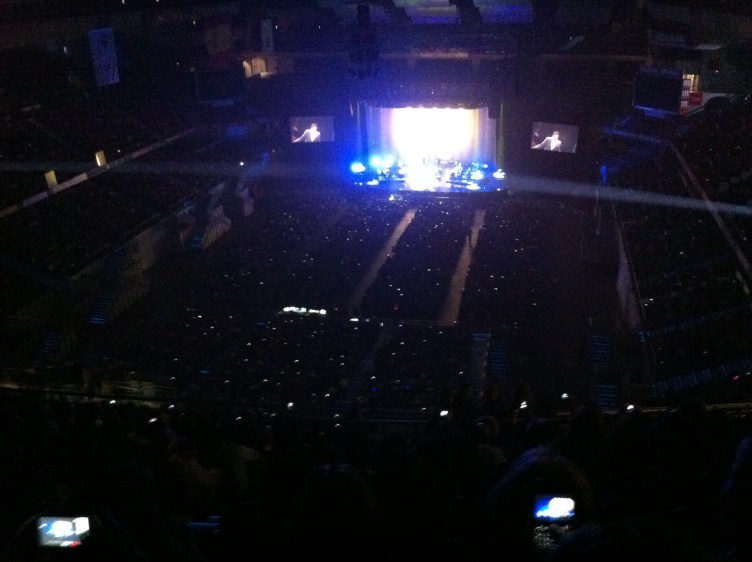
Mira esta foto. Ahí hay 12.000 personas. Es el Palacio de los Deportes de Madrid. 12.000 personas que están pendientes de lo que ocurre en el escenario. Porque acaba de salir al escenario Michael Bublé. ¿Y qué son esas luces? ¿Son mecheritos? ¿La gente se ha puesto romántica y quiere sacar el mecherito como en los conciertos de hace 10 ó 20 años?

No señor. No son mecheritos. Son teléfonos móviles que están grabando el espectáculo. ¿Cuántos habrán colgado luego este video en youtube? Bueno. Podemos hacernos una idea si ponemos en youtube Michael Bublé Madrid. ¿Ha pagado Bublé por esa publicidad, por esa visibilidad? No. Pero es que Bublé es muy bueno.

Me dirijo a ti Bodega. Cuando entras en Internet con tu página web, de entrada, no eres Michael Bublé, subida en el escenario. Eres una de las 12.000 personas que llenan el recinto. Y vistas así juntas no parecen muy distintas unas de otras. Parecen iguales. Eso es lo que consigues estando en Internet. Y eso lo consigues casi gratis. Enhorabuena.

Está chupado triunfar en Internet. Está tan chupado como hacer un vino de muy alta calidad. Está chupado para los enólogos encumbrados que llevan años y años de estudios, aprendizaje y prueba y error. Está chupado para Michael Bublé que lleva años y años practicando y trabajándose por hacerse un hueco en la élite musical.

Siendo muy bueno en lo tuyo y haciendo una buena labor por Internet (página web, Social Media), puedes hacerte tu propio escenario de personas que te siguen. Porque tú no necesitas llenar recintos con 12.000 personas en todas las capitales del mundo. Lo que sí necesitas es diferenciarte y ganarte a determinadas personas repartidas por el mundo, una a una. De modo que si ellas reclaman tu producto, estén donde estén puedas venderles, ya sea a través de tus distribuidores e importadores o directamente.

Apóyate en alguien que sepa para que te ayude, pero solo si eres bueno en lo tuyo. ¿Es más barato que en los medios tradicionales? Sí. Pero no gratis. Porque está chupado estar en Internet. Pero es bastante más complicado hacerte un hueco.

Para los que estuvieron en el concierto, para los que les gusta Michael Bublé. Y para los que les gustan los tíos con un par de narices ahí va la última canción que cantó. Esta canción la cantó «a capella». Significa sin micrófono… en un recinto de 12.000 personas. ¿Y qué consigue Michael Bublé acabando con una canción «a capella»? De entrada, emocionarme como no lo había hecho en el resto del concierto. Consigue D I F E R E N C I A R S E. Se puede resumir en dos palabras: «Im presionante» .


Este post en inglés: Is the Internet free? The Michael Bublé Concert in Madrid.

Concierto De Michael Bublé

I think we’re all a bit fed up with this “everything’s free on the internet” thing.

It’s true that many programs and tools are in fact free in Internet. Everyone repeats this so often that it seems that it’s easy to succeed on the internet – and at no cost!

“Do you want to have a massive internet presence for free?” No problem! Just set up a webpage, get onto FaceBook, et voila!

Look at this photo. There are 12,000 people there. It’s the Palacio de Deportes Concert Hall in Madrid. 12,000 people all watching the stage. All watching Michael Bublé. An what do you think those little lights are? Do you think that all those people feeling nostalgic for the 60’s and 70’s and that they’ve taken out their lighters?

Nope! They’re not lighters – they’re mobile phones! And they’re all recording videos of the show. How many people will then upload their videos onto YouTube? Check it out yourself – just typeMichael Bublé Madrid” at YouTube. Do you think the Bublé paid for all that publicity, for all that visibility? Nope! But Bublé is already very famous.

Wineries! When you create a webpage, the first thing you have to know is that you’re not Michael Bublé on the stage! You’re one of the 12,000 people in the audience, who are not very different from each other. That’s what you get when you launch your presence for free on the internet.

Sure it’s easy to triumph in the internet. It’s as easy as producing a good quality wine. It’s easy for famous winemakers who have years of experience and recognized qualifications. It’s easy for the likes of Michael Bublé who also has years of experience and who’s already worked hard to reach the top of his profession.

If you’re good at what you do and do your homework to create an internet presence, then you can go on-stage and have thousands of followers or fans. And you don’t have to fill stadiums in cities around the world. What you have to do is differentiate yourself and win over individual followers from all over the world., one by one. So if they want to buy your product, you will be in a position to sell it to them, no matter where they are, either via a distributor or directly to them.

Use the skills of someone who knows how to do this, but only if you’re good at what you do. Is this cheaper than the traditional way? Yes, but it’s not free. It’s easy to be part of the audience in the internet, but it’s a bit more complicated to get up on the stage.

For those of you who were at the concert, and for those of you who like Michael Bublé, here’s the last song he sang: he sang it ‘a capella’ which means without a microphone. What was the point of him singing a song without a microphone? Well firstly, it was the emotional climax of the whole show, and secondly, he managed to D I F F E R E N T I A T E himself.


This post in Spanish: ¿Es gratis Internet? Concierto de Michael Bublé