Visita a Bodega Conde de los Andes de PaterninaVisit to the Winery Conde de los Andes de Paternina

He estado esta semana pasada en esta Bodega.

Cuantas más bodegas visito más disfruto. El sector del vino es una caja de sorpresas. No suele decepcionar. Y tampoco ha ocurrido en esta ocasión. Les dije a los señores de Paternina que pretendía visitar sus instalaciones, y me invitaron a que fuera a visitar sus instalaciones en Ollauri. En realidad la gran Bodega está en Haro, pero Haro es la eficiencia y Ollauri es el encanto.
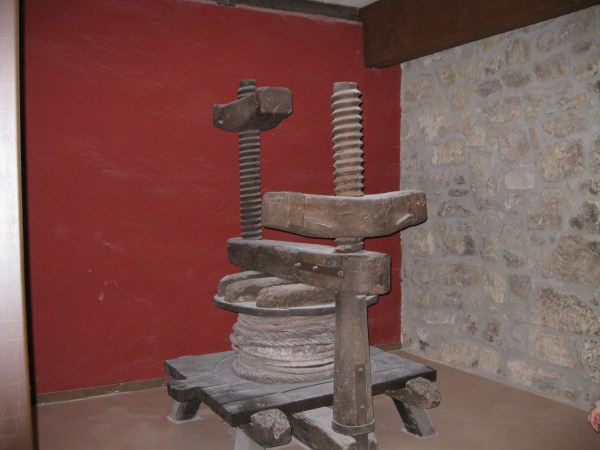
Prensa de hace 240 años

La bodega está enclavada en un pueblo típico de Rioja. Me puse a dar vueltas por el pueblo pero no encontraba la bodega. Esta era una de las sorpresas que me esperaban en esta visita. Por fin veo a una chica sentada que se levanta cuando me ve llegar y me saluda. Es Beatriz, la persona que me va a acompañar, una chica joven, muy maja, afable y amable. Luego comprobaré que además cuenta con un muy atractivo discurso.

Empezamos la visita. Entramos en una sala muy elegante que parece ser utilizan para eventos de empresa. En las paredes podemos ver enmarcadas las bandas de las etiquetas. La bodega data de 1896. Y se nota. Rápidamente bajamos a la Bodega.

En la visita a bodega vamos a pasar de 18 metros de profundidad hasta los 40 m, para salir dos calles más arriba en el pueblo.

Esta era la bodega de Paternina originalmente, pero hubo un momento en el que se quedó pequeña y se fueron a Haro para poder hacer la ampliación.

En esta Bodega envejecen los Reservas y Grandes Reservas de Conde de los Andes. Consiguen aquí mantener las mejores condiciones: temperatura constante de 11 grados, sin ruido, poca luz, ideales para el envejecimiento del vino. 

El producto no sale hasta que no hay un pedido, y pasa por Haro.
Blanco Reserva Conde de los Andes>

Nos encontramos un par de prensas, una de ellas con 240 años de antigüedad perfectamente conservadas

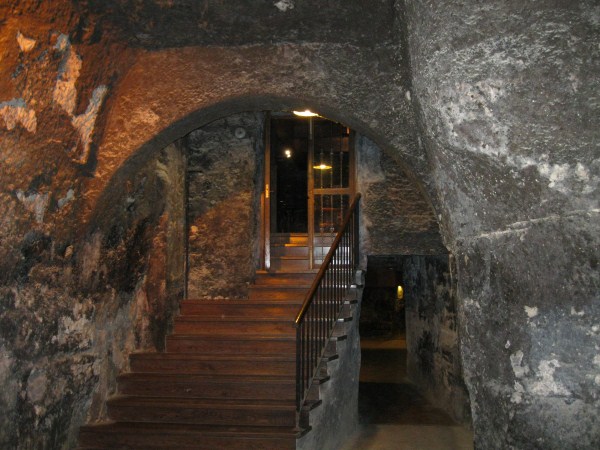
Y empezamos a bajar. Y a bajar, porque hay unas cuantas escaleras.

He visto otras bodegas subterráneas, pero ésta impresiona llena de producto envejeciendo con el producto perfectamente apilado.

Se puede apreciar la enorme y costosa manipulación que conlleva el sistema que tienen y que debería de repercutirse en el precio. (Curiosamente el precio de sus productos no es alto)

Me muestra las tinas donde se fermentaba en su momento el vino antes de la ampliación: una de esas tinas se está aprovechando como mostrador del restaurante que está justo encima. Posteriormente veré el restaurante (tan espactacular coomo la Bodega)

La Bodega data de 1896 pero las cuevas tienen más de 400 años. Están picadas a mano por canteros gallegos que picaban cuando no estaban trabajando en el campo. Si miras con atención la roca  puedes imaginar el trabajo tan duro que tuvo que ser picar y picar. Eran hombres hechos de otra pasta supongo.
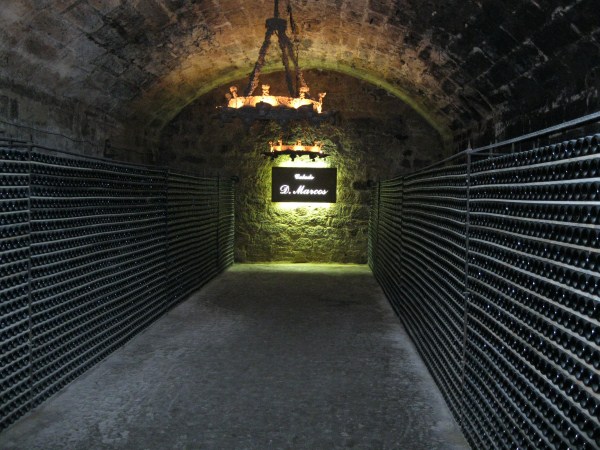
Calado en homenaje a don Marcos Eguizábal

Me cuenta Beatriz que el producto Federico Paternina Banda Azul (crianza) es un homenaje a todos esos gallegos que trabajaron aquí. Para el Reserva tienen el Banda Roja, que en España se vende con la marca Viña Abial.

En su momento las botellas se bajaban en carretillas por las escaleras que hemos bajado, pero era tremendamente laborioso y muchas botellas se rompían. ¿Podía llegar alguna sin que se rompiera? (Ver escalera)

Podemos ver un mar de botellas, todas ellas tumbadas.

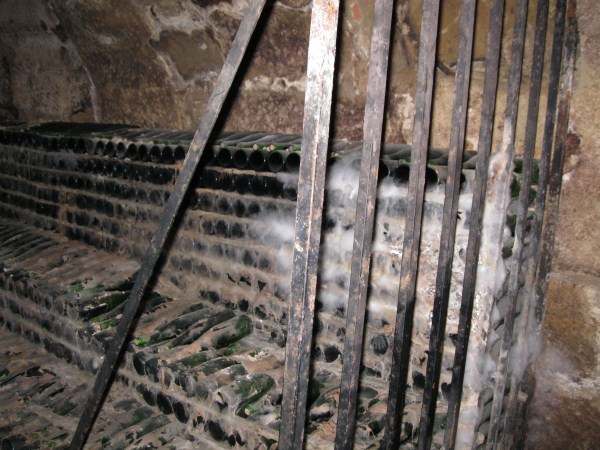
Me enseña el Blanco reserva Conde de los Andes. Este vino solo se produce en añadas excelentes como fueron el 74, el 82, el 95 y 2001 que es el que se comercializa ahora. Es un espectáculo ver el moho que se acumula por la humedad (entre el 75 y el 82%).

Pasamos al lado de las cubas donde se envejecía el vino. Son unas cubas enormes que obligaban a los cuberos a tener que construirlas allí dentro. Este es un buen lugar para decir aquello de “tener ojo de buen cubero”.

Vemos el calado en homenaje a don Marcos Eguizábal dueño de la Bodega que murió el año pasado. La estancia es espectacular. En ese calado hay almacenadas unas 100.000 botellas. Es el más grande de la Bodega. Antes de la ampliación de Haro había barricas. Se subían las mismas en el piso superior para el trasiego que se hacía y se hace cada 6 meses. Aún se puede ver el roce de las cuerdas al izar barricas de 200 y pico kilos. ¡Qué esfuerzo, qué trabajo más enorme se puede uno imaginar!

Pasamos al lado de una cepa con más de 200 años de edad. Parece ser anterior a la enfermedad de la filoxera. Mide más de 2 metros y parece que te fuera a hablar. Impresionante.
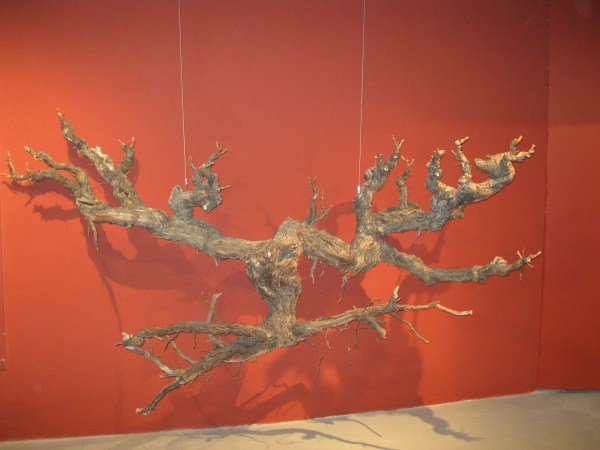
Una cepa de 200 años

Vemos unas enormes fotos en blanco y negro de los años 1920-1930. Las fotos son fantásticas y transmiten al observador cómo se trabajaba en la viña y en Bodega entonces. Podemos ver a uno de los trabajadores trabajando con el cigarro en la mano. Eran otros tiempos.

Pasamos a la zona con jaulones en la que el trabajo se hace algo más fácil al poder entrar algunas máquinas.

Y vemos las barricas. Solo hay las 50 preceptivas que impone la DO. Antes había 3000 hasta que se trasladaron a Haro.

Me presenta el vino Graciela. Hay detrás una historia preciosa. Se trata de un blanco, crianza y semidulce.

Me enseña donde descansan los vinos más antiguos. A esta zona le llaman con razón la “Capilla Sixtina”
Entrada a la Vinoteca

Pasamos a la vinoteca y me invita a degustar el Graciela, y un tinto reserva Conde de los Andes 2004. Después de haber hecho el recorrido disfruto con la degustación como niño con zapatos nuevos. ¿Existe una mejor manera de degustar que haber visto justo antes todos los argumentos por los que un vino es lo que es?

Reciben 10000 visitantes al año y tratan de conseguir más eventos de empresa y bodas que, en principio son más rentables que las visitas de turistas en pequeños grupos.

Y me enseñan el restaurante. El detalle del mostrador es una pasada.Y el restaurante en su conjunto tiene un gusto y un estilo exquisito. Me comentan que el cubierto puede rondar por los 35/40 euros. Me da la sensación de que la relación precio calidad es muy buena.
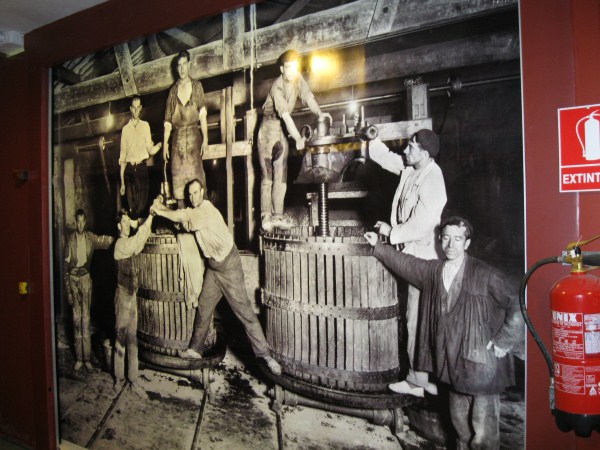
La Bodega en 1920

Recomiendo a todo el que pueda que visite esta bodega que se trata de una experiencia extraordinaria.

Paternina. Conde de los Andes. Otro de los grandes. Chapeau.

Este post en inglés: Visit to the Winery Conde de los Andes de PaterninaLast week I went to this Winery.

The more wineries I visit, the more I enjoy what I do. The wine sector is full of surprises –I rarely feel disappointed, and of course, this was not an exception. I told the owners of Paternina that I wanted to visit their Winery and they invited me to spend some time at their premises in Ollauri. The truth be said, although their great Winery is located in Haro, and it  represents the efficiency while Ollauri´s recalls charm.

Prensa de hace 240 años

The Winery is located in a typical village of La Rioja Region. When I got there, I started wandering around the village but I could not find the Winery. This was one of the surprises I was about to have during my visit. I finally saw a young lady who stood up as I approached her who said hello to me. She was Beatriz, the person who would spend the day with me –a young nice, gentle and friendly woman, with whom I had very interesting conversations.

 We started our visit by entering a very elegant room, which seemed to be used for company events. On the walls we could see all labels framed hanging. The Winery has been working since 1896, and you can feel the passing of time in the environment. We immediately went down to the winery.

During our visit, we went from 18 meters depth to 40, which took us to an exit located two streets far from the entrance. 

This was the original Paternina Winery, but there was a moment back in time it was not large enough and they had to move to Haro in order to enlarge the business.

This is the Winery where Conde de los Andes Reserve and Grand Reserve age, as it is the place with the best conditions –constant temperature (11 degrees), absence of noise, and not much light; all these essential characteristics for wine ageing.

The product is not prepared until it is ordered and managed in Haro.

Blanco Reserva Conde de los Andes>

While walking we found a couple of wine pressesone of them is about 240 years old– which were in perfect conditions.

We started going down, down and down… there were many steps before us.

I have seen other underground wineries, but this one is impressive because there is a huge amount of product ageing perfectly piled.

 As you move on, it is possible to see how hard and expensive it must be to manage their working system, which undoubtedly should be reflected in the price. (Surprisingly as it may seem, the price of their products is not too high).

Then Beatriz showed me the tanks where wine is fermented –one of such tanks is being used as the restaurant counter, which is located right above the winery. I saw the restaurant afterwards, and I can say it was as amazing as the Winery.

The Winery was founded in 1896, but the caves are more than 400 years old. Such caves were excavated by Galician quarrymen while they were not working in the field. If you look carefully at the rocks, it is possible to imagine how hard it was to complete such works. I guess those men were simply different from today’s.

Calado en homenaje a don Marcos Eguizábal

Beatriz told me that the product Federico Paternina Banda Azul (Crianza) is a homage to those Galician men who worked there. For Reserve, they use the Banda Roja, which is sold in Spain under the brand Viña Abial

Bottles used to be transported by wheelbarrows down the stairs we had just walked through, but this was tremendously difficult and many bottles resulted broken. Could any of them really reach its destination unbroken? (See the staircase)

Beatriz showed me the Conde de los Andes White Reserve. This wine is only produced after excellent vintages, such as 74, 82, 95 and 2001, which is the one currently being sold. It is an amazing experience to see how humidity (between 75 and 82%) makes mould grow on the bottles.

We walked around the barrels where the wine was ageing. These barrels are huge, and the idea that coopers had to manufacture them inside the winery comes to my mind. In this case, the “rule of thumb” worked perfectly.

 We saw the breathtaking wine storage room devoted to Mr Marcos Eguizábal (the owner of the Winery who died last year), where there are more than 100,000 bottles. It is the largest room in the Winery. Before the Haro enlargement, there were barrels there too, which were transported to the upper floor every six months for all cyclic works. It is still possible to see the marks of the ropes used to lift the over-200-kilo barrels. It must have been impressive to see such a hard task!

 As we moved on, Beatriz showed me a vine over 200 years old. It seems it was planted before the vine pest. This two-meter-tall tree is so alive that it seems it wants to talk. Simply impressive. 

Una cepa de 200 años

Then we saw some huge black-and-white pictures taken in the 1920’s or 1930’s. They are fantastic and they show the visitor the way works were performed in the Winery at that time. We can see one of the employees working while holding a cigarette in his hand. Times were different then.

Our visit then led us to the cages area, where works may be performed much more easily as machines may enter the premises.

And we saw the barrels. The are only 50 of them which are perceptive, according to the requirements of the Designation of Origin (DO). There were 3,000 barrels before they moved to Haro.

Then Beatriz presented me the Graciela wine, and told me the beautiful story behind it. Before us, we have a white, a crianza and a semi-sweet wine.

After that, I am taken to the place where vintage wines are stored. This area is understandably called the “Sistine Chapel”.

Entrada a la Vinoteca


Then we moved to the wine collection and I tasted the Graciela and a red Conde de los Andes reserve wine from 2004. After the walk, I felt like being on cloud number nine while tasting such amazing products. Is there any better way to taste wine right after having seen all the process preceding such a great result?

At this Winery, they receive around 10,000 visitors every year, although they are trying to get more company events or marriage celebrations to be held at their premises, as they bring in better returns in comparison to small tourist groups.

And then they showed me the restaurant. The counter is simply amazing, and the restaurant in the whole is very stylish and elegant. They say the average price per person is 35/40 euro. I think it is a good value for money.

La Bodega en 1920

I recommend everyone to visit this Winery, as I am sure it will be an extraordinary experience.

 Paternina. Conde de los Andes. Another great one. Chapeau.

 This post in Spanish: Visita a Bodega Conde de los Andes de Paternina
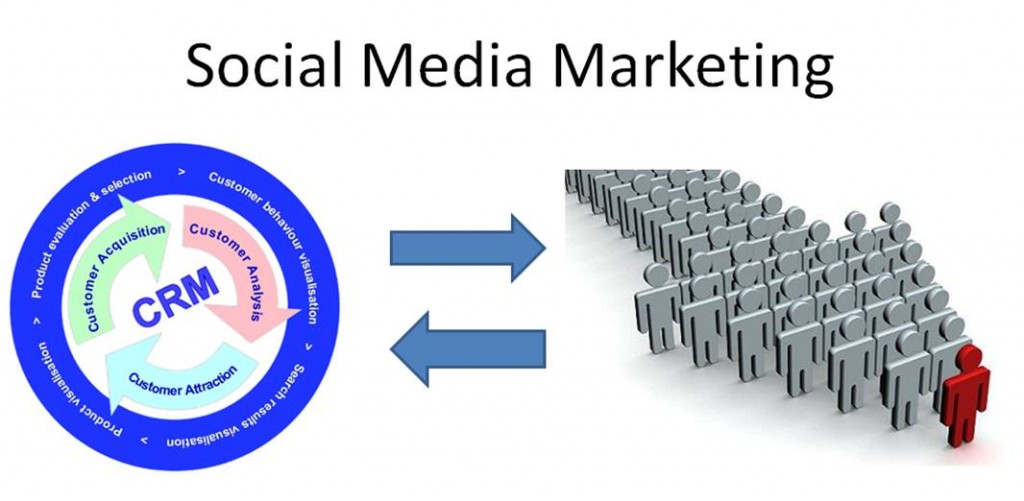
El CRM y los Social Media se dan la mano.The CRM and the Social Media get together.

Social Media Marketing

Si las empresas ven atractivo el Social Media es básicamente por: 1) Conseguir una mayor visibilidad. 2) Mejorar su reputación. 3) Vender más.

A través de los Social Media las Bodegas entran en contacto con consumidores, con prescriptores, con intermediarios, con curiosos en general, y lo suyo es tener la antena puesta para, si a través de un contacto tenemos la oportunidad de informar, tratar de convencer y dar un trato especial para, si  nuestro contacto es prescriptor, conseguir nos prescriba, si es consumidor que nos compre, ya sea directamente o a través de un intermediario, y que nos prescriba en su entorno de amigos e influencia, y si es intermediario para que nos compre y nos venda.

En este blog hablamos de comunicación por Internet para vender más. Y debemos disponer de una herramienta que nos permita actuar del modo que más nos conviene en función de nuestro interlocutor.

El CRM es una herramienta que nos permite sistematizar la relación teniendo en cuenta la singularidad de cada cliente y de cada contacto. Se trata de personalizar la comunicación y al mismo tiempo estandarizarla si descubrimos homogeneidades que nos permiten realizar tratamientos y comunicaciones homogéneas.

Personalmente creo que los Social Media tienen mucho que aportar al CRM y viceversa. De su interrelación sale una mucho mayor potencia de comunicación, siempre que no perdamos de vista en ningún momento que los social media nos están recordando que detrás de cada contacto hay una persona con nombre y apellidos, con gustos y características únicos, una persona que valora y agradece un trato personalizado.

Confluencias como esta son las que permiten decir que el Social Media Marketing está adquiriendo su mayoría de edad.

Imagenes de: cochabamba.gov.bo, lg-ingenieria.com

Este post en inglés: The CRM and the Social Media get together.

Social Media Marketing

There are many reasons why companies find Social Media attractive; 1) reaching more visibility, 2) improving their reputation, and 3) selling more.

Wineries get in contact with consumers, consumer motivators, intermediaries, and interested public in general through Social Media. Therefore, it is important to always keep our eyes open, in order to be able to inform, convince or give preferential attention to a contact –in case of consumer motivators, it is important for us to become recommendable; regarding consumers, we should make possible our product is purchased –whether directly or indirectly– and recommended to their friends and relatives; and, finally, in the case of intermediaries, we must ensure our product is purchased and sold.

In this blog we talk about communication through the Internet as a mean to increase sales. Therefore, we need a tool allowing us to work in the most convenient way.

The CRM is the systematization of our contacts with the idea that each customer must be treated according to his characteristics. It is about making communication personal and standard at the same time in case homogeneities supporting treatment or communication are found.

I personally believe that the Social Media has a lot to offer for the CRM and vice versa. As a result of such an interaction, there is greater communication power, bearing in mind that Social Media always reminds us of the person behind each contact, who is a person with a name and a surname, with different likes and personal characteristics, who is willing to receive customized treatment.

Circumstances like those mentioned above make us believe that the Social Media Marketing is becoming adult.

Images from: cochabamba.gov.bo, lg-ingenieria.com

This post in Spanish: El CRM y los Social Media se dan la mano.

La importancia de la calidad del discurso en la visita a Bodega. The importance of telling a good story, when visiting a winery.

Ilusionista

Cada día que pasa le voy dando más importancia al cuidado que determinadas bodegas le prestan a la visita a sus bodegas.

El negocio de las bodegas está cambiando de forma radical por muchos motivos: porque la competencia se hace más dura, porque al entrar en una competencia globalizada cada vez se hace más importante diferenciarse, porque diferenciarse a través de unas instalaciones modélicas es una tarea más sencilla que hacerlo simplemente por las características de un producto, una etiqueta, una botella, un embalaje, porque disponer de una instalaciones llamativas permite un mucho mejor discurso, porque ya no se trata de convencer a cuatro expertos que consideran que es suficiente el producto para definirse ante él.

Ahora son miles, millones de consumidores que siguen su propio criterio, por lo menos parcialmente. Y muchos de ellos buscan información de primera mano. Algunos con una enorme sensibilidad para catar, pero la mayor parte, que necesitan más referencias para opinar sobre un vino.

Pero siendo importantes las instalaciones lo son tanto o más la calidad del que cuenta la historia y cómo la cuenta.

Cuando hablamos de los magos les definimos como ilusionistas. Y son ilusionistas porque con un truco saben adornar una actuación para dejarnos con la boca abierta. Ese ilusionista puede no estar en el entorno más apropiado, pero si tiene una buena historia que contar y la cuenta de forma  atractiva y apasionada nos encantará. Ese mago brillará mucho más si lo hace en un reducto apropiado. Recomiendo a los visitantes  de Madrid ir a “La Cripta Mágica” en Madrid.

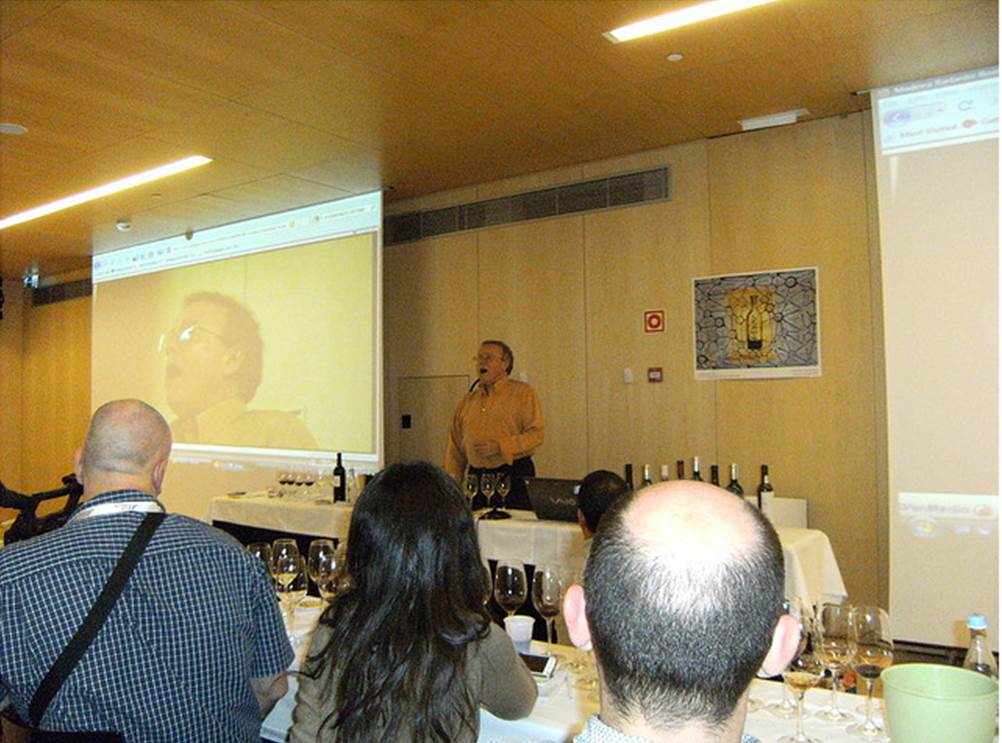
En el mundo del vino no hablamos de trucos, pero hablamos también de ilusionar, de emocionar, de ensalzar y cantar las bondades y pequeños detalles de un vino, de una bodega. Un buen ejemplo de esto es lo que viví con Charles Metcalfe  en su presentación en la European Wine Blogger Conference en Lisboa.

Sé que no es lo mismo disponer de alguien tan increíble como Charles para que dé un discurso maravilloso, que contratar a alguien para que haga 200 recorridos al año para una Bodega. Pero de lo que se trata es de acercarse en lo posible a ese tipo de discurso. La mayor parte de las bodegas de cierto tamaño, con buenas instalaciones que mostrar  y con buenos conocimientos del Marketing del vino tienen guías con buena formación y aptitudes. Saben que el factor humano hay que cuidarlo.

Procuremos tener unas instalaciones de las que sentirnos orgullosos, pero no dejemos atrás la formación, la motivación , la actitud de nuestros guías.  Controlemos la calidad del discurso que realizan, porque con el aumento de las visitas a Bodega, y este es un dato inexorable (19% de crecimiento en número de visitas a Bodegas en el último año), cada vez será más importante esta actividad en la cuenta de resultados.

Solo falta que el número de visitantes se multiplique, que las bodegas se den cuenta de las ventas que pueden hacer con esas visitas, que se den cuenta de lo importante que es mantener una relación directa con sus clientes reales finales y potenciales, (CRM) (Customer Relationship Management) (Gestión de la relación con nuestros clientes) para las ventas en los próximo años, y veremos también a mejores profesionales, mejor pagados, más formados y más motivados en hacer bien su trabajo como elemento clave en la cuenta de resultados de la Bodega.

Tiempo al tiempo. Tempus fugit.

Este post en inglés: The importance of telling a good story, when visiting a winery. 

Post relacionados:
Contar mil historias distintas una vez vs contar la misma historia mil veces
La importancia de contar una buena historia.
Solar de Samaniego. Cada vino tiene una historia. Cada historia tiene su vino. En elmundo.es
Visita a Bodegas Marqués de Riscal. Una historia que contar.
Abadía Retuerta. ¿La mejor historia mejor contada?

Foto de: Taringa.net

Ilusionista

With each passing day I value more and more the care and diligence with which some wineries treat their visitors.

A winery’s business model is changing radically for a number of reasons: because competition is getting fiercer; because it’s becoming ever more important to differentiate (due to the global marketplace); because it’s easier to differentiate via interesting installations than via the technical characteristics of the product, label, bottle, packaging, etc; because having interesting installations provides a talking point; and because it’s not a question any more of just convincing a bunch of experts that your product is up to scratch.

Now there are thousands, or millions, of consumers out there who follow their own criteria, at least in part, and

Many of them seek first-hand information. Some are experienced tasters, but the vast majority need more varied information in order to be able to form an opinion on a given wine.

But even though the installations themselves are important, I think that even more important is the quality of the story and how it’s told.

When we talk about magicians, we usually define them as illusionists. They are illusionists because they know how to put on a show and leave us gob-smacked. The illusionist may not be working in the perfect setting, but if he has a good story to tell and he tells it passionately and in an interesting way, we lap it up. A magician will shine all the more if he does his thing in the right setting. I recommend visitors to Madrid to see “La Cripta Mágica”.

In the world of wine, we don’t usually talk about tricks, but we do talk about dreams, emotions, fantasies and talking up the qualities and small details of a given wine, or of a given winery. A good example of this is the talk given by Charles Metcalfe the European Wine Blogger Conference in Lisbon.

I know it’s not the same thing to have an amazing personality such as Charles giving one talk, and contracting someone to show visitors round a winery umpteen times a week all year! But the idea is to aim for the quality of that kind of talk. Most wineries of a certain size and with good installations and with some idea of marketing do have good guides who are well trained and a good attitude. The wineries know that you have to cater to the human factor.

It’s good to have installations to be proud of, but let’s not forget about training, motivation and attitude. Keep an eye on what the tour guides actually say, because with the increase in winery visits (datum: 19% increase in visits over previous year), this area will have a significant impact on the bottom line.

It’s a question of time before we see the number of visits skyrocketing, and wineries will catch on to the fact that they can increase sales in their tasting rooms; and they will realize how important it is to establish a direct contact with their potential customers (Customer Relationship Management). We will also see better professionals, who will be better paid, better trained and more motivated to do a good job, as a key element in contributing to a wineries bottom line.

All things come in time. Tempus fugit.

This post in Spanish: La importancia de la calidad del discurso en la visita a Bodega.

Photo from: Taringa.net

Hacer cosas nuevas para seguir aprendiendo.Doing new things to keep learning.

«Los analfabetos del siglo XXI no serán aquellos que no sepan leer y escribir, sino aquellos que no sepan aprender, desaprender y reaprender”

– Alvin Toffler (escritor y futurista)

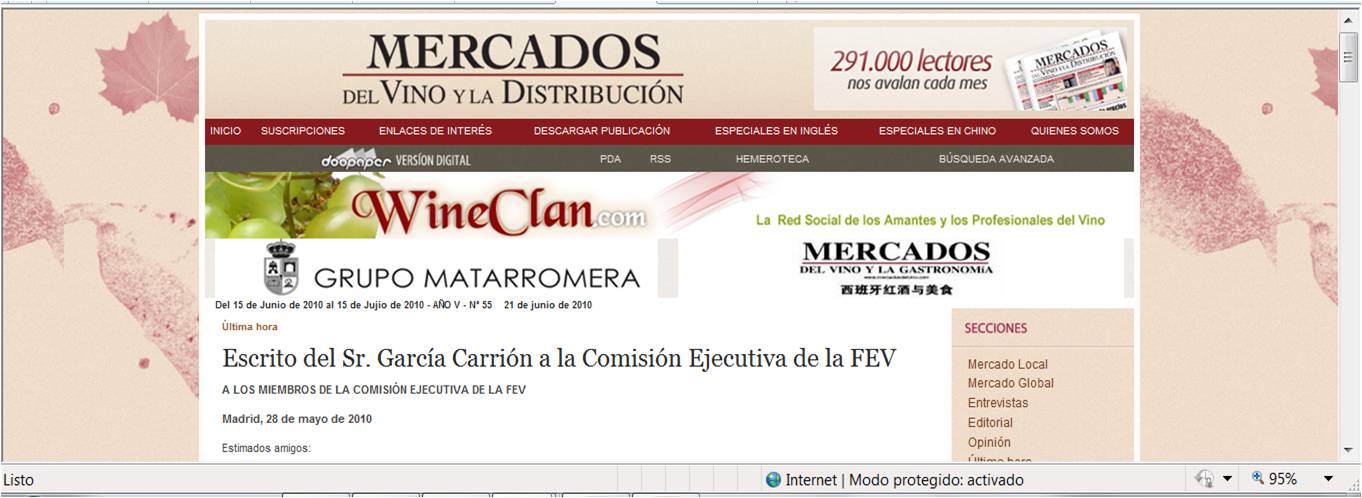
Recupero una empresa con la que colaboré hace tiempo: Mercados del Vino y la Distribución. Su origen se encuentra en el empuje de Mónica Muñoz Blanco, presidenta, editora, y alma mater del proyecto. Aparte de empuje, Mónica parecía aficionada a la innovación, y comenzaba a pelear por desarrollar ideas poco convencionales contra viento y marea. Ese tipo de personas que sacan los pies del tiesto, se llevan no pocos palos, pero al final consiguen hacer cosas nuevas y desarrollarlas.

Portada de mercadosdelvino.es

La idea de un periódico especializado en el mercado del vino y dirigido no al consumidor, sino a los profesionales, para estructurar y mejorar el sector, ha ido tomando forma y despejando dudas hasta convertirse en un referente. Y con la que está cayendo sigue en lo más alto, lo que no deja de sorprender.

Estoy seguro de que Mónica ha tenido más de cinco, diez, o quince momentos en los que podía haber abandonado el proyecto, pero su forma de hacer las cosas, o en este caso de no dejar de hacerlas, no se lo ha permitido. Gracias a ello bodegueros grandes o pequeños siguen teniendo una fuente importante de información. Esto ayuda a vertebrar el sector y con ello a mejorarlo, hacerlo más profesional, permitir que la información circule.

Algunos comentaban que el sector del vino estaba lleno de empresas demasiado tradicionales, pequeñas, arcaicas, poco profesionalizadas… (Duele decirlo, pero habrá que hacerlo por si es cierto. No es así ¿no? Bueno, menos mal). Es importante que estas empresas tengan un punto de referencia, un medio que no sea ni bodeguero, ni administración, ni distribuidor, ni proveedor y aporte su granito de arena.

En la web de Mercados del Vino pueden encontrar información del mercado local, de exportaciones o situación de otros mercados, de I+D, marketing, distribución, opinión, eventos… ¿no ayuda esto a llevar el timón de una empresa?

Pero esto es lo normal. Lo que ya es más raro son las apuestas de Mónica por acciones que nadie más hacía entonces: Desarrollo de especiales, monográficos, premios empresariales, desayunos debate; y lo sorprendente es que sigue haciéndolo ahora con más fuerza si cabe. ¿Y no sería mejor dejar de hacer estas cosas “extras” hasta que remita la crisis? Pues debe pensar que no. Y por lo que parece la idea es ponerse a hacer cada vez más.

Especial de Mercados del Vino y la Distribución para Shanghay en chino

Recientemente también han realizado especiales en inglés de la edición impresa, para tratar de los vinos españoles en ferias internacionales (otra idea original que ayuda a las bodegas a venderse fuera, aparte de que la DO les pague el stand de turno). Y para rematar un especial en chino para Shangai.

Celebro que Mercados del Vino siga gozando de buena salud, y de que sirva de ejemplo a la hora de no detenerse y afrontar nuevos proyectos con originalidad. Si eres un medio y dices que el sector debe hacer cosas nuevas y renovarse, debes comenzar por ti mismo para dar ejemplo: bien, pues estos lo hacen. Enhorabuena a Mónica y su equipo.

O lo que es lo mismo. Aprenden, desaprenden y reaprenden.

Fotos: Web Mercados del Vino y la Distribución.

Post en inglés: Doing new things to keep learning. «The illiterates of the XXI century will not be those who don’t know how to read and write, but those who don’t know how to learn, unlearn and relearn!»

– Alvin Toffler (writer and futurist)

This post is about a project in which I participated some time ago: Mercados del Vino y la Distribución. It was started by Mónica Muñoz Blanco, who is the chairwoman, editor and alma mater of the Project. Apart from having loads of energy, Monica seemed to be addicted to innovation, and started off trying to develop some rather unconventional idea, fighting against wind and tide. These type of people, who are not afraid to think outside the box, often suffer more than a few setbacks, but in the end they succeed in doing new things and in developing their ideas.

Portada de mercadosdelvino.es

The idea of a news-sheet specialized in the wine world but not directed to consumers but to professionals, with a view to structuring the sector better, has taken shape and has actually become a point of reference. And given the economic state of affairs today, this is surprising to say the least.

I’m sure there have been at least 10 or 15 occasions when Monica could have given up on the project, but her way of doing things (or in this case her way of not doing things) didn’t allow her to. Thanks to her, large and small wineries alike have an excellent source of information available to them. This helps to give structure to the wine sector, to improve it, to make more professional, and to allow information to circulate.

Some people have commented that the wine sector is full of wineries that are too traditional, too small, too archaic, too unprofessional,… (it hurts to say that, but it has to be said, just in case it’s true. But it’s not like that, is it? Good, just as well!). It’s important that these wineries have a point of reference, an entity that is neither a winery, nor the public administration, nor a distributor, nor a supplier.

In Mercados del Vino’s webpage, you can find information on the local market, exporting, the situation in foreign markets, R&D news, marketing, distribution, opinions, events, etc. Is all this not a great help to the people running a winery?

But this is normal. Unusual are Monica’s actions, that no-one else did at that time: development of special numbers, specialized papers, corporate prizes, breakfast debates, etc. It’s surprising that she’s still doing this kina of thing now, and with more energy than ever. Would it not be better to leave off doing these “extra” things until the recession ends? Apparently she doesn’t think so. On the contrary, it seems that she’s going to even more than before!

Especial de Mercados del Vino y la Distribución para Shanghay en chino

Recently, she has issued special printed numbers in English, dealing with Spanish wines at international wine fairs – another original idea that helps wineries sell abroad (apart from just the DO covering the cost of the stand, as per usual). Her latest is a special issue in Chinese for the ShangHai market.

I’m pleased that Mercados del Vino is still going strong, and that it can be used as an example of not living up when going gets tough, and of taking on new and innovative projects. If you are in means of communication and you think that that the sector should do new things and renovate itself, you should put your money where your mouth is, and give an example. Congratulations to Monica and her team.

Put another way: learn, unlearn and relearn.

Photos: Web Mercados del Vino y la Distribución.

This post in Spanish: Hacer cosas nuevas para seguir aprendiendo.

El milagro de la venta de vino en un restauranteThe miracle of selling wine in a restaurant

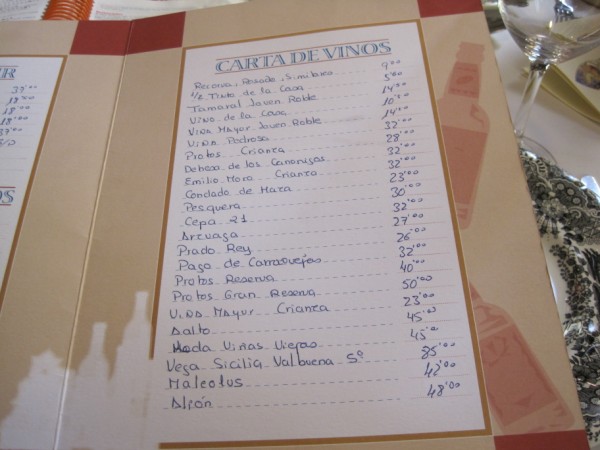
Carta de vinos

Entro a comer en un buen restaurante de Valladolid capital.

Tenemos claro que vamos a tomar un lechazo y una ensalada mixta.

Le pido al camarero la carta de vinos.

Le echo un vistazo de arriba abajo.

Hay 23 vinos en la carta. Trato de imaginarme los enormes esfuerzos que cada una de las bodegas presentes en la carta han tenido que hacer para conseguir hacerse un hueco en este prestigioso restaurante de Valladolid.

En muchos casos, la labor de venta de la bodega acaba ahí.

Siendo importante que compren tu vino, no lo es menos que te vendan. Porque se trata de generar rotación. Todos los negocios se hacen mayores de edad, no cuando te compran por primera vez, sino cuando hay repetición de compra. Esto indica que todo el proceso de venta ha funcionado y que hemos cumplido con las expectativas del consumidor. Por ello, el cliente satisfecho repite compra.

Se trata de que no solo te compre el restaurante sino que te compre el cliente del restaurante. Que éste quede satisfecho y hable bien de tu producto y del servicio que ha recibido. Que, al agotarse tu producto haya un nuevo pedido en tu bodega.

¿Dispone el restaurante de un sommelier? ¿Qué porcentaje de las ventas del restaurante surgen por recomendación del restaurante? ¿Influye estar el primero o de los primeros en la carta? ¿Influye que la carta de vinos esté repartida en diversas páginas? ¿Marca un margen exacto de recargo sobre el precio de coste? ¿Aplica un margen distinto a determinadas marcas por tener mucho más stock? ¿No deberíamos de seguir trabajándonos a los clientes para que, no solo nos compren sino que nos vendan?

Y ahora. Te cedo el sitio. Ya no eres bodeguero. Eres el cliente que está en el restaurante y se va a comer el lechazo y la ensalada. ¿Qué vino pedirías de los que hay en la carta y por qué?

Tenía un profesor de Marketing que decía que todo lo que ocurre en el mercado es sencillísimo y evidente. Evidente significa que hay que verlo. Y cuanto más cerca se esté del proceso de compra mejor. ¿Y cuál es el momento más importante? Cuando el consumidor final realiza el acto de compra. Ese es el momento culminante. Todo lo que hagan los intermediarios, comprando para luego vender es también muy importante. Pero nada funciona a medio y largo plazo si no hay un consumidor que decida o se deje aconsejar en el momento de la compra.

Soy todo oídos. Por favor explícame qué vino has elegido y por qué, que quiero aprender.

Post en inglés: The miracle of selling wine in a restaurant

Carta de vinos

I get into a good restaurant to have lunch in Valladolid. We know for sure we want to have lamb and mixed salad. I ask the waiter to bring the Wine Menu. I take a look at it and I see it offers 23 wines. I come to understand the great efforts the Wineries represented in this Menu had to make in order to be present in such a prestigious restaurant in Valladolid. In many cases, selling activities of Wineries finish here.

 There is no doubt that not only it is important that others buy your wine, but also the fact it is actually sold. The main aim is to create rotation. All businesses become mature, not only when your product is purchased for the first time, but also when it is purchased for a second. This is a sign that shows the selling process has worked and that we have met the customer’s expectations. The truth is that a satisfied customer always buys your product again.

The main objective is that not only the restaurant purchases your product, but also the restaurant customers –customers must be satisfied with both the product and the service received. And another goal is that the restaurant makes a new order of your product when they run out of stock.

Does the restaurant have a sommelier? What is the restaurant sales percentage related to restaurant recommendations? Is there any influence in being at the top of the wine list? Does it have any influence the fact the wine menu has several pages? Does the restaurant have a precise margin of profit over the cost price? Do they apply a different margin of profit according to specific brands for stock reasons? Shouldn’t we continue focusing on the client to ensure that not only do they buy our products but also sell them?

 And now it is your turn. You are not a wine producer anymore. You are the customer sitting at the restaurant and you are about to eat lamb and salad. What wine would you order from the ones in the menu and why?

I had a Marketing Professor who used to say that everything happening in the market is simple and evident. Evident means that it must be seen, and the closer you are to the purchase process, the better. What is the most important moment? No doubt it is the moment when the final consumer buys the product –this is the highest point. All the actions carried out by third parties to purchase and sell are also important. But nothing works in the medium and long term if there is not a consumer to decide or to accept being advised at the moment of purchase.

I am all ears. Please tell me which wine you chose and why –I want to learn.

This post in Spanish: El milagro de la venta de vino en un restaurante